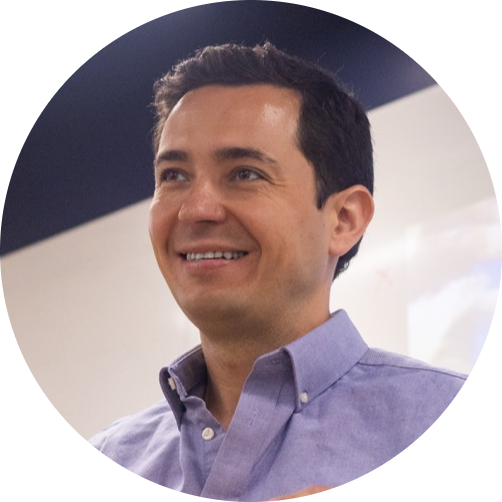
Fernando Alvear

Hi, I’m Fernando.

I am a Math & STEM teacher, I do philosophy and cognitive science, and build web apps.

Teaching
I am a math and STEM teacher at St. Louis University High School. I teach Algebra and Python to freshmen, and also CAD, Programmable Electronics, Foundations of Engineering, and Product Innovation to all other grade levels. I coach the Robobills, FRC Team 5176.
Outreach
I lead the Guatemala STEM Project, through which SLUH supports STEM education at Esperanza Juvenil in Guatemala City, a boarding school for students from rural areas with limited access to education.
Philosophy
I hold a PhD in philosophy and work in virtue epistemology and moral psychology. I recently published a paper on blame and childhood adversity, and I am currently writing a paper on how people trust professionals who used AI during their training.
Software
I build web applications with JavaScript and PHP.
Not on the job market, for now.
Virtue epistemology and the epistemic environment

How the conditions we think in shape whether our beliefs count as knowledge.

Did Your Doctor Use AI in Med School? Effects of Disclosed AI Use During Training on Trust in Experts

Prior work asks how patients react to AI used at the point of care. We ask a different question: whether learning that an expert’s competence was developed with AI assistance changes how much that expert is trusted. Participants recruited on Prolific read a vignette about a doctor who recently finished training, with the training history manipulated between subjects, and then rated their comfort and confidence along with the doctor’s ability, benevolence, integrity, and autonomy of judgment: Mayer, Davis, and Schoorman’s model of trust, extended with a fourth dimension for independence of thought.

Study 1
Used AI / did not use AI / no information, cardiologist scenario. N = 216.
Study 2
Adds a peer-tutor arm, to separate a penalty for AI specifically from a penalty for any outside help. N = 335.
Method
Preregistered. One-way ANOVA with corrected pairwise contrasts, then parallel mediation (PROCESS model 4, 10,000 bootstrap samples).
Read the poster

Zoomable, and open for comments.

Mathematics & STEM Teacher

2024 – present

St. Louis University High · St. Louis, MO

I teach Algebra 1 and lead a sequence of design-and-build STEM electives — innovative product development, computer-aided design, Python programming, and programmable electronics. The work is a chance to bring the same habits of careful reasoning I care about in philosophy to problems students can hold in their hands.

Graduate Instructor of Philosophy

2020 – 2024

University of Missouri · Columbia, MO

Alongside my doctoral work I taught undergraduate courses in bioethics, ethics, logic and critical thinking, and the meaning of life, both in the classroom and online.

Philosophy Faculty

Summers 2023 – 2024

Missouri Scholars Academy · Columbia, MO

A three-week residential program for academically gifted high-school students from across Missouri, where I taught introductory philosophy and a course in logic and critical thinking.

Adjunct Instructor

2016, 2021 – 2024

Fontbonne University, Pittsburg State University & Universidad Alberto Hurtado · Missouri, Kansas & Santiago, Chile

Across several institutions I taught philosophy of religion, bioethics, ethics, contemporary philosophy, and critical thinking as an adjunct and visiting instructor.

Courses taught

St. Louis University High2024 - Current
Algebra 1 · Innovative Product Development · CAD (OnShape) · Computer Programming (Python) · Programmable Electronics
Fontbonne University2024
The Quest For God (Philosophy of Religion)
Missouri Scholars Academy2023 – 2024
Introduction to Philosophy · Logic and Critical Thinking
University of Missouri2020 – 2024
Introductory Bioethics · The Meaning of Life · How to Think (Logic and Critical Thinking) · Introduction to Ethics
Pittsburg State University2021 – 2022
Introductory Bioethics · Logic and Critical Thinking · Introduction to Ethics
Universidad Alberto Hurtado2016
Filosofía Contemporánea
  1. Robbins, P., & Alvear, F. (2026). Love, Money, and Blame: Effects of Emotional and Economic Hardship on Judgments of Criminal Behavior. Behavioral Sciences & the Law, 44(3), 479–494.

  2. Robbins, P., & Alvear, F. (2023). Deformative Experience: Explaining the Effects of Adversity on Moral Evaluation. Social Cognition, 41(5), 415–446.

  3. Robbins, P., Alvear, F., & Litton, P. (2021). Good Deeds and Hard Knocks: The Effect of Past Suffering on Praise for Moral Behavior. Journal of Experimental Social Psychology, 97, 104216.

ORCID — full list of works.

Classroom tools, dashboards and course material I wrote for my students and my own work.

Feel free to contact me at .